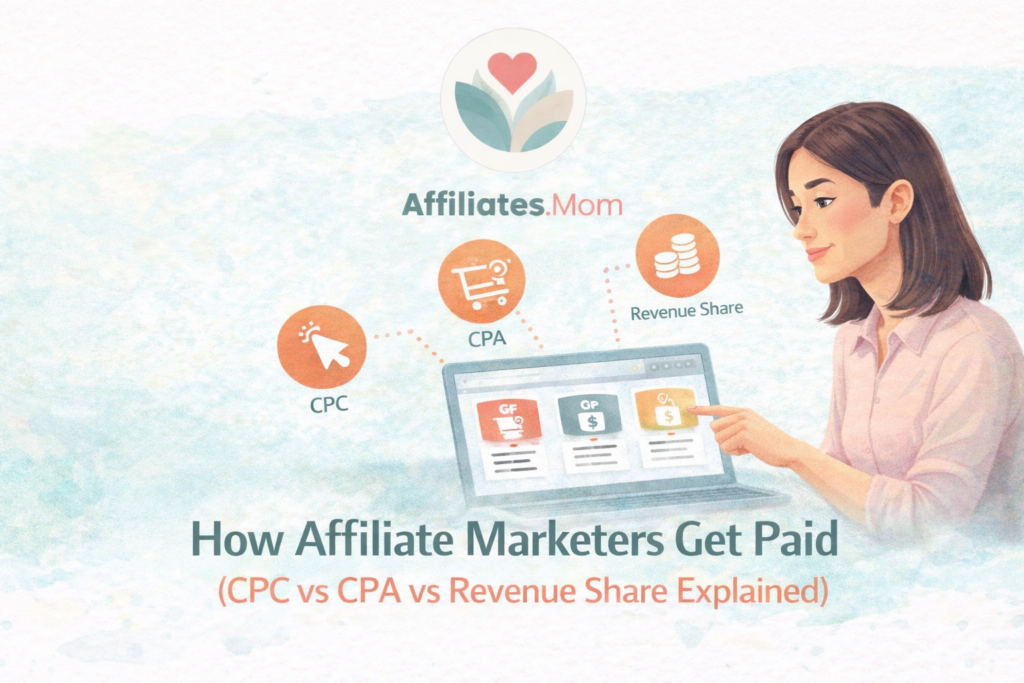
How Affiliate Marketers Get Paid (CPC vs CPA vs Revenue Share Explained)
n Part 4, we repaired trust.
Now we refine the structure.
You’re ready to recommend products.
But before you do, you need to understand how you actually get paid.
Because not all affiliate programs work the same way.
The acronyms can feel like a secret code:
CPC.
CPA.
Revenue Share.
Many beginners choose programs based on commission percentage alone.
That’s the wrong starting point.
This is a foundational decision.
It determines:
- What behavior you’re rewarded for
- How patient your strategy must be
- Whether your audience stage matches the payout model
Let’s break this down clearly.
The Three Main Affiliate Commission Models
1️⃣ CPC (Cost Per Click)
You get paid when someone clicks your affiliate link.
Not when they buy.
Not when they sign up.
Just when they click.
Best for:
- Early-stage audiences
- High traffic content
- Educational or comparison posts
- Low-friction offers
Example scenario:
You write a beginner guide comparing website builders.
Your audience is still researching.
A click-based model rewards that curiosity stage.
CPC usually pays less per action, but conversion barriers are lower.
2️⃣ CPA (Cost Per Action)
You get paid when someone completes a specific action.
Usually:
- Makes a purchase
- Signs up for a trial
- Submits a form
This is the most common affiliate model.
Best for:
- Solution-aware readers
- Review content
- Clear recommendations
- Higher intent traffic
CPA requires more trust than CPC, but payouts are typically higher.
3️⃣ Revenue Share
You earn a percentage of the customer’s spending.
Sometimes:
- One-time commission
- Recurring monthly
- Lifetime revenue share
This model rewards long-term alignment.
Best for:
- Subscription products
- Software tools
- Courses
- Membership programs
Revenue share often produces smaller initial payouts but larger long-term earnings.
Simple Comparison Table
| Model | You Get Paid For | Risk Level | Best For Audience Stage | Earning Potential |
|---|---|---|---|---|
| CPC | Click | Low | Curious / Early Research | Low per action, scalable with traffic |
| CPA | Purchase/Action | Medium | Solution-ready | Medium to High |
| Revenue Share | Ongoing Spending | Medium | Committed users | High long-term |
Why Beginners Pick the Wrong Model
The common mistake:
Choosing the highest commission percentage.
But percentage alone means nothing.
If your audience is early in their journey, pushing a high-commitment CPA offer won’t convert.
If your audience is ready to buy and you’re promoting CPC-only offers, you’re leaving income on the table.
The model must match the maturity of your audience.
Match the Commission Model to the Audience Journey
Ask yourself:
Are you guiding early curiosity?
Or recommending a final solution?
If your content answers basic “What is this?” questions, CPC or low-friction CPA may fit.
If your content addresses “Which one should I choose?” questions, CPA or revenue share aligns better.
Alignment creates natural promotion.
Misalignment creates friction.
The Real Goal
Picking the right model isn’t about maximizing commission rate.
It’s about aligning payment with the value you provide.
When those are in sync:
- You don’t feel pushy.
- Your content feels helpful.
- Recommendations feel logical.
- Conversions increase naturally.
When they’re not in sync:
- You over-explain.
- You pressure.
- You doubt your own pitch.
- Sales stall.
How This Connects to Your Website Strategy
If you don’t yet have a clear website foundation, your commission model won’t matter much.
You need:
- A focused niche
- Clear audience positioning
- Trust-driven content
- A simple technical setup
If you’re starting from scratch, build that first.
👉 Create Your Affiliate Website Quickly and Simply
If you prefer a guided framework instead of guessing:
👉 Explore the Newbie Success Formula
Structure first.
Monetization second.
Final Thought
Affiliate marketing isn’t about chasing the highest payout.
It’s about matching:
Audience → Content → Trust → Commission Model
When those pieces align, income becomes predictable instead of accidental.
In Part 6, we’ll build the foundation that makes those recommendations believable in the first place.
Because authority comes before income.