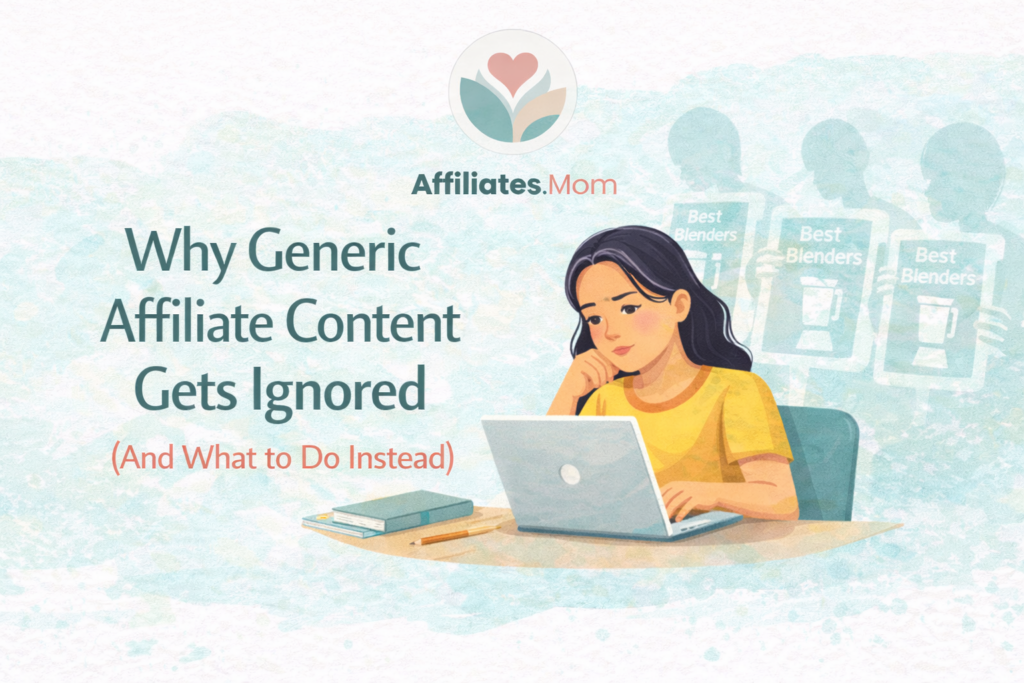
Why Generic Affiliate Content Gets Ignored (And What to Do Instead)
In Part 2, we moved beyond waiting for one traffic source to find us.
Now comes a quieter challenge.
You know you need to create content.
But every topic feels taken.
You search your idea and see:
“Best Blenders of 2026”
“Top 10 Budget Blenders”
“Ultimate Blender Comparison Guide”
So you hesitate.
If it’s already been written 50 times, what’s the point?
The Problem Isn’t Competition. It’s Perspective.
Writing the 51st article on “best blenders” isn’t a strategy.
It’s a recipe for invisibility.
The issue isn’t that the topic exists.
The issue is that most content is interchangeable.
Anyone can list features.
Anyone can copy specifications.
Anyone can summarize reviews.
But very few people own a perspective.
And perspective is what builds authority.
Covering a Topic vs. Owning a Frame
Covering a topic looks like this:
• Listing product features
• Repeating common pros and cons
• Summarizing what’s already ranked
Owning a perspective looks like this:
• Comparing tools for a specific type of person
• Testing a product in a real-world situation
• Explaining why one option works better for a certain scenario
• Sharing what went wrong and what you learned
Your value isn’t in the list.
It’s in the frame.
What “Owning a Perspective” Actually Means
You don’t need more expertise.
You need more honesty.
Instead of writing:
“Best Blenders Under $100”
You could write:
“Best Blender for a Busy Mom Who Just Wants Smoothies Done in 2 Minutes”
Instead of:
“Top Email Marketing Tools”
Try:
“The Email Tool I Switched To After Wasting 3 Months on the Wrong One”
That shift changes everything.
Because now it’s not generic.
It’s contextual.
Context Builds Connection
People don’t connect with comprehensive information.
They connect with relatable context.
They want to know:
• Does this solve my exact problem?
• Has someone like me tried this?
• What happened when they did?
When your content feels like a conversation instead of a catalog, it stands out.
You’re no longer competing on volume.
You’re competing on relevance.
Use Experience, Not Just Information
You don’t need to pretend to be an expert.
Instead, document:
• What you’re testing
• What surprised you
• What didn’t work
• What you would do differently
Real examples:
“I chose this program because the dashboard was simpler.”
“I switched because the payout model didn’t match my audience.”
“I thought this tool would save time. It didn’t.”
That transparency builds trust.
And trust drives clicks.
Specific Beats Broad
Broad content attracts general attention.
Specific content attracts the right person.
Instead of trying to appeal to everyone:
Speak clearly to someone.
When your content feels tailored, it resonates.
And resonance leads to action.
How This Connects to the Bigger Picture
In Part 2, we talked about not relying on one traffic source.
Part 3 adds another layer:
Even if people find you, generic content won’t hold them.
Visibility gets attention.
Perspective builds authority.
Authority builds trust.
Trust leads to income.
If You’re Just Starting
If this feels overwhelming, simplify it.
You don’t need:
• 50 blog posts
• A viral strategy
• A massive audience
You need:
• A simple website
• A clear niche direction
• Honest, perspective-driven content
If you don’t yet have a website, start with something simple.
👉 Create Your 60-Second Affiliate Website
If you prefer step-by-step structure:
👉 Explore Newbie Success Formula
You don’t win by being louder.
You win by being clearer.
Tomorrow in Part 4, we’ll look at what happens when people arrive — but don’t take action.
Because content alone isn’t enough.